Tensor Data Interchange for AI/ML Systems: A Survey and the Hurray Proposal
Pascal Gillet
pascalgillet@ymail.com
Revision: September 2026 · Also available as PDF
Hurray project: https://pgillet.github.io/hurray/
Source code and specification: https://github.com/pgillet/hurray
Abstract
AI/ML systems move large amounts of tensor data between libraries, processes, machines, accelerators, and storage. Model weights are loaded from files into accelerator memory. Frameworks exchange tensors without copying them. Distributed training splits tensors across GPUs. Disaggregated inference transfers key-value (KV) caches between prefill and decode workers.
A tensor is a multidimensional array of values. Moving a tensor from one system to another requires transferring its data, but also enough information to interpret that data: its element type, shape, and memory layout, i.e. how its elements are arranged in memory. Some tensors require additional information. Quantized tensors store values using lower-precision encodings and associated parameters such as scales. Sparse tensors store selected values together with indexes instead of storing every value. Paged KV caches use blocks whose physical order can differ from their logical sequence order. Tensors can also be split, or sharded, across several devices.
Several interchange solutions cover parts of this information. DLPack describes strided tensors in memory, including their device. Apache Arrow defines dense and sparse tensor IPC (inter-process communication) representations and has added fixed- and variable-shape tensor types to its columnar data model. SafeTensors and GGUF store model tensors in files, with GGUF supporting many quantized representations. Zarr and NetCDF store large multidimensional arrays. NIXL and UCX move memory efficiently between machines and devices, while NCCL provides communication operations between GPUs.
This paper compares these solutions and the tensor information they preserve. The comparison shows a practical gap for tensors whose physical representation matters to computation. Layout, quantization, device memory, paging, and sharding increasingly appear at the boundaries between runtimes, but among the systems surveyed here, no widely used interchange format combines these properties in one tensor description reusable across memory, files, and network transfers.
We then present Hurray, an open-source tensor interchange project designed for this use case. Hurray defines a language-independent descriptor for a tensor's type, shape, layout, quantization, device and memory placement, buffers, and composition. The same descriptor is used for streaming and persistent files and can accompany data moved through existing communication systems.
The goal is simple: when two runtimes support the same tensor representation, they should be able to exchange it without first converting it to an intermediate layout. When they do not, the difference should be explicit so that the required conversion can be selected.
1. Introduction
AI/ML applications rarely run inside a single library.
A Python application may prepare input with NumPy, execute a model with PyTorch, call kernels through CUDA, exchange tensors with another runtime, and store model weights in SafeTensors or GGUF. A distributed training job can split one tensor across dozens or hundreds of accelerators. An inference service can compute a KV cache on one GPU and consume it on another machine.
At each boundary, two things have to move: the tensor data and the information needed to interpret it.
For a simple tensor this information is small. Consider a float32
matrix with shape [1024, 4096], stored consecutively by rows. A
receiver needs to know the data type, the two dimensions, and where the
data starts.
Modern tensor representations can be more complicated.
A matrix may be transposed without moving its data. A GPU kernel may require values to be stored in tiles. A four-bit weight tensor may pack several values into each byte and use one scale per block. A sparse matrix may consist of a value buffer and several index buffers. A KV cache may be divided into pages spread across GPU memory. A distributed tensor may be split across several GPUs.
These representations matter because converting between them costs time and memory bandwidth.
The raw parameter payload of a 70-billion-parameter model is about 140 GB at 16 bits per parameter and about 35 GB at 4 bits per parameter, before quantization metadata and other overheads. Converting a tensor of this size merely to cross a software boundary can require reading and writing tens or hundreds of gigabytes of memory.
The same issue appears at smaller scales but higher frequencies. An inference server can transfer KV-cache blocks for many requests between workers. If producer and consumer already support the same cache layout, converting those blocks to a generic dense representation before transfer is unnecessary work.
A tensor interchange format determines how much of the original representation survives such a boundary.
This paper surveys existing approaches to tensor interchange. It covers in-memory interfaces, data formats, scientific array storage, communication systems, and recent work on distributed inference. The systems considered include DLPack, Apache Arrow, SafeTensors, GGUF, ONNX, Zarr, NetCDF, NIXL, UCX, and NCCL, with MLIR, PJRT, and PyTorch DTensor considered as adjacent approaches.
The survey then considers Hurray, an open-source project that defines a broader tensor descriptor covering layout, quantization, memory placement, and tensor composition.
Hurray is currently a beta, pre-1.0 project. Its relevance therefore depends less on its current adoption than on the question examined in this paper: can one stable tensor descriptor carry enough of the execution representation --- layout, quantization, placement, buffers, and composition --- to be reused at runtime, in streams, and in files?
2. What Describes a Tensor?
2.1 Shape and data type
A tensor generalizes a scalar, vector, or matrix to any number of dimensions.
A vector of length 10 has shape [10]. A matrix with 1024 rows and 4096
columns has shape [1024,4096]. A batch of 32 RGB images with height
and width 224 may have shape [32,3,224,224].
The number of dimensions is the tensor's rank. The tensor also has
an element type, such as float32, float16, bfloat16, or int8.
Shape and type describe the logical array, but not necessarily how it is stored.
2.2 Dense tensors and strides
A dense tensor stores a value for every position in the array.
The simplest dense layout stores values consecutively. A C-style matrix normally stores one complete row after another. A Fortran-style matrix normally stores one complete column after another.
Many tensor libraries use strides to describe more general layouts.
For a tensor with indexes (i_0,...,i_{n-1}), an ordinary strided
representation can calculate the element position as:
o + sum(i_k * s_k)
where o is an initial offset and s_k is the stride of dimension k.
Strides make many tensor operations cheap. A transpose can often exchange dimensions and strides without moving the underlying values. A slice can adjust the starting offset and strides. Broadcasting can use a zero stride for a repeated dimension.
DLPack uses this model. It covers a large and important set of tensor views, but not every layout used by current accelerators and inference systems.
2.3 Memory layout
The memory layout of a tensor is the rule that maps a logical
element such as [i,j,k] to the bytes that store it.
Strides are one such rule.
A tiled layout divides a tensor into smaller rectangular blocks and specifies how the blocks and their contents are ordered. Tiling can improve cache locality or match the matrix representation expected by accelerator hardware.
A packed layout rearranges values into the exact order a particular instruction or kernel reads them, and the result may no longer be described by one ordinary stride per dimension.
A paged layout divides the tensor into separately allocated blocks. A table maps logical regions of the tensor to those physical blocks. KV-cache management in modern LLM serving systems is an important example.
The layout is therefore part of the information a consumer needs if it wants to use the existing representation directly.
2.4 Sparse tensors
A sparse tensor avoids storing positions whose value is implicitly zero or another default value. Instead, it stores selected values plus indexes identifying their positions. Instead of storing a million-element matrix with only ten thousand non-zero values, a sparse representation stores those ten thousand values and the indexes that locate them.
COO, or coordinate format, records coordinates for stored values. CSR, or compressed sparse row format, compresses indexes by matrix row. CSC performs a similar operation by column. Higher-dimensional sparse arrays can use structures such as CSF, compressed sparse fiber.
A sparse tensor is consequently often made from several buffers: values, indexes, and offsets. Shape alone cannot describe it.
Apache Arrow is notable here because it defines standardized sparse tensor representations in addition to dense tensors.
2.5 Quantization
Quantization stores numerical values at lower precision to reduce memory use and often increase compute throughput.
A simple affine scheme can reconstruct an approximate value as
x_hat = s(q-z), where q is the stored integer, s a scale, and z
a zero point. The scale can apply to the whole tensor, one channel, or a
small block of values.
Other schemes work differently. NF4 uses a small codebook. Block floating-point formats share scaling information across groups. Microscaling formats combine low-precision values with block-level scales.
A quantized tensor can therefore require more information than a data-type name: the logical type, storage type, quantization scheme, scales and optional zero points, grouping or block size, and, for sub-byte values, how bits are packed.
Two formats both called "4-bit" are not necessarily compatible.
2.6 Where the tensor is stored
Tensor data can reside in different kinds of memory.
Host memory is memory directly available to the CPU. Accelerator memory is memory associated with a GPU or another accelerator. Unified memory provides an address-space abstraction shared across processors, with the underlying system managing access or migration.
Other relevant cases include pinned host memory, operating-system shared memory, GPU memory accessible by peer devices, and memory registered for RDMA.
This information matters for zero-copy interchange. A consumer may understand a tensor's layout perfectly but still be unable to access its buffers where they currently reside.
2.7 Sharding and tensor composition
Large tensors are often divided among devices. This is called sharding. Distributed training systems treat tensor partitioning over devices as a first-class concern [17].
For example, a matrix with shape [65536,16384] might be divided by
rows across eight GPUs. Each GPU stores a [8192,16384] shard.
Describing each shard independently does not describe the global tensor. The receiver also needs to know which part of the global tensor each shard represents.
A related concept is tensor composition. In this paper, that means describing one tensor or tensor artifact using several constituent tensors or regions. It can cover shards of one distributed tensor, several named tensors grouped in one model, sparse values and their index tensors, a quantized tensor and its scale tensors, and heterogeneous regions stored in different formats.
3. What an Interchange Format Needs to Do
3.1 Describe the tensor
The receiver needs enough metadata to interpret the buffers. For a basic dense tensor, this means shape, type, and layout. Other tensors can require sparse indexes, quantization parameters, page tables, or information about constituent tensors.
3.2 Avoid copies when possible
Zero-copy interchange means the receiver reads the producer's existing buffer rather than a copy of it. What crosses the interface is a pointer or a memory handle, not the bytes.
Zero-copy is not always possible. The receiver must understand the representation, be able to access the memory, satisfy alignment requirements, and observe the correct lifetime and synchronization rules. Buffer alignment is the requirement that a buffer start at an address that is a multiple of some specified size. Particular instructions and device interfaces can require it, and where they do not, it can still affect throughput. A format can state a minimum alignment rather than leaving it to convention. Synchronization matters because the producer may not have finished: if an accelerator is still writing the data, the consumer must wait for the appropriate synchronization point before reading it.
A format cannot guarantee zero-copy in every situation. It can provide enough information for the receiver to determine whether zero-copy is possible.
3.3 Stream large tensors
A streaming representation should let the receiver read the tensor description first and then process its payload incrementally. This is useful for network transfers and pipelines where a tensor can begin moving before the complete object is available at the destination.
3.4 Read individual tensors from files
A model can contain hundreds or thousands of named tensors. A reader should be able to locate one tensor without scanning or loading the entire file. Memory mapping is also useful because the operating system can map file pages into the process address space and load them on demand.
3.5 Work across languages
A tensor format is more useful when its definition does not depend on a Python or C++ object. DLPack and Apache Arrow both use language-neutral specifications and C-compatible interfaces to connect independent implementations. Such an interface is an ABI, or application binary interface: a fixed binary representation of structures and calls that separately compiled components can rely on without agreeing at source level.
3.6 Stay separate from the transport
Describing a tensor and moving its bytes are different jobs.
Shared memory, TCP, RDMA, CUDA IPC, NIXL, UCX, and other mechanisms can all carry data. A tensor descriptor does not need to replace them. It needs to tell the receiving application what the transferred buffers contain.
4. DLPack: In-Memory Tensor Exchange
DLPack [1] is one of the most widely used mechanisms for exchanging tensors between machine-learning frameworks.
Its basic DLTensor structure carries a data pointer, a device, the
number of dimensions, a data type, a shape, strides, and a byte offset.
Current DLPack also defines low-precision floating-point data types,
including several FP8 and smaller formats. Managed tensor structures add
lifetime information so the consumer and producer can coordinate
ownership.
This is already a useful tensor descriptor.
A PyTorch tensor can, for example, be passed to another DLPack-compatible framework without converting it into an intermediate file or copying its data simply because the framework changes.
DLPack is especially well matched to ordinary strided tensors. It also carries device information. Its scope is intentionally small.
DLPack does not define a file format or a network framing protocol. A
DLTensor describes one tensor rather than a distributed group of
shards. Its core tensor structure does not provide standard descriptions
for sparse indexes, paged KV caches, arbitrary accelerator tiling, or
generic quantization parameters.
DLPack's main strength is precisely that a small common representation
is easy for frameworks to adopt, and the Python array ecosystem has
converged on it. The Python Array API Standard [25] weighed the Python
buffer protocol and __cuda_array_interface__ against it and chose
DLPack as its recommended protocol, on the grounds that a device-specific
protocol leaves a consumer no defined order in which to try protocols,
and that "DLPack has the widest support". The CUDA Array Interface [26]
is itself worth noting here, because it demonstrates the same model on
GPUs: a device pointer, shape, typestr, optional strides, and a
stream field naming the stream on which the producer may still have
work in flight, so the consumer knows what to synchronize against.
5. Apache Arrow
Apache Arrow [2] is the most mature example of a common physical data representation shared across many languages and systems.
Arrow is primarily designed for the tabular model: data as a set of records, typically rows from a relational database, each a set of named typed fields, stored in a columnar physical representation, with buffers defined by each Arrow type. Its basic objects are arrays, record batches, and tables. The Arrow specification defines their in-memory representation independently of a particular language implementation. The C Data Interface allows libraries in one process to share Arrow buffers, while Arrow IPC defines serialized messages for exchanging Arrow data between processes or storing it in streams and files.
Arrow also has substantial tensor support.
5.1 Standalone Tensor
Arrow defines a standalone Tensor structure [3] for multidimensional
arrays. The representation contains tensor shape and strides and can
therefore describe conventional strided multidimensional arrays.
Arrow also defines alignment rules for these tensor IPC structures. Standalone tensor bodies are aligned to 64-byte boundaries.
5.2 SparseTensor
Arrow separately defines SparseTensor [3].
This is significant because sparse tensors cannot in general be reduced to shape plus strides. Arrow defines standard sparse index structures and specifies how the associated buffers are represented.
Arrow therefore covers more than one tensor layout family.
5.3 Tensor-valued Arrow columns
Arrow also defines the canonical extension types
arrow.fixed_shape_tensor and arrow.variable_shape_tensor [4].
These allow tensor-valued observations to participate in Arrow's normal columnar data model. The fixed-shape representation records tensor shape and can include dimension names and a permutation between logical and physical dimensions. The variable-shape representation supports tensor values whose dimensions vary.
The elements of these canonical tensor extensions are stored in row-major, C-contiguous order. A permutation can change the logical interpretation of dimensions, but it does not define an arbitrary tiled or paged physical layout.
5.4 Arrow Flight
Arrow Flight [5] provides high-performance network transfer for Arrow data. Flight uses Arrow IPC and gRPC with implementation optimizations designed to avoid unnecessary serialization and memory copies, and published benchmarks report multi-gigabyte-per-second transfers with high utilization of the available network bandwidth [6].
Flight is therefore strong prior art for network data interchange. The more relevant difference for computational tensors is what the transferred metadata describes.
Arrow's mature streaming ecosystem is centered on its columnar data model and RecordBatches. Its tensor structures do not provide a general description of accelerator-specific packed layouts, quantization schemes, paged KV caches, device memory, or distributed tensor composition.
5.5 What Arrow establishes
Arrow demonstrates that a public physical format can be shared by independent implementations; metadata and buffers can be separated; the same data model can support memory sharing and serialized interchange; alignment can be part of the format; extensions can add domain-specific semantics; and high-performance network transfer can be built around the same representation.
These principles are a major influence on Hurray.
6. Tensor and Array Files
6.1 SafeTensors
SafeTensors [7] is a simple format for storing named tensors, particularly model weights. Its header records tensor names, types, shapes, and byte ranges. The format supports memory-mapped and selective access.
SafeTensors deliberately keeps the tensor representation simple. It is not intended to describe a live GPU allocation, a paged cache, a sharded tensor, or a kernel-specific packed matrix.
6.2 GGUF
GGUF [8] is a model format developed in the GGML ecosystem. It stores model metadata and named tensors in one file and is especially relevant because it supports many quantized tensor types.
Types such as Q4_0 and Q4_K identify concrete GGML encodings. Their
block structure, scales, and packing follow the definition of the
selected GGML tensor type rather than a generic quantization descriptor
stored with each tensor.
GGUF therefore provides strong prior art for preserving quantized representations in a portable artifact. Its quantization model is tied to named GGML tensor encodings rather than a general parameterized quantization descriptor intended for arbitrary runtimes.
6.3 Zarr and NetCDF
Zarr [9] divides large multidimensional arrays into independently stored chunks. NetCDF [10] provides named multidimensional scientific variables and supports partial access, with modern NetCDF storage able to use chunked layouts through HDF5.
These formats show that large arrays need not be loaded as complete files. Their layouts primarily optimize persistence and data access rather than the in-memory representation expected directly by accelerator kernels.
6.4 ONNX
ONNX [21] is a model interchange format, and its tensor representation
is part of that. TensorProto carries dims, a data_type, and the
values either in typed fields or in raw_data. SparseTensorProto
pairs a values tensor with an indices tensor and the dense dims.
Quantization parameters can be associated with tensors through
annotations rather than fields of TensorProto itself: a
TensorAnnotation maps a tensor name to the names of its quantization
parameter tensors through quant_parameter_tensor_names, so scale and
zero point are themselves tensors. The data type enum includes low-bit
types, among them UINT4, INT4, FLOAT4E2M1, and the FLOAT8
variants. Tensor data need not sit inside the file: setting
data_location to EXTERNAL moves the bytes to a file identified by
location, with optional offset, length, and checksum.
ONNX therefore covers more of this paper's subject than a weights-only format does. Its scope is different. The tensor representation is part of a computational-model interchange format, the storage model is more constrained than an execution-layout descriptor, and it is not intended as a transport-independent physical tensor descriptor carried unchanged through runtime memory, streams, and files.
7. Moving Data: UCX, NIXL, and NCCL
Tensor formats and communication libraries solve different problems. The former describe data. The latter move it.
UCX [11] provides communication primitives over different hardware transports and generally treats transferred memory as buffers whose meaning is supplied by the application.
NIXL [12] targets point-to-point data movement in distributed inference and abstracts memory and storage types including GPU HBM, CPU DRAM, SSDs, and distributed storage. On suitable systems, it can use GPU Direct RDMA to transfer data directly between registered GPU memory regions.
NCCL [13] provides optimized collective and point-to-point communication between GPUs. It can use several paths depending on the hardware, including PCIe, NVLink, InfiniBand, and network sockets.
These systems do not need to understand that a buffer is a tiled matrix or a paged KV cache. A tensor interchange format can complement them by providing the description shared by the applications at either end.
8. Adjacent Systems: Compilers, Runtimes, and Frameworks
Three systems describe parts of a tensor without being interchange formats. They mark the boundary between describing a representation and exchanging one.
MLIR memref. The memref type [22] carries a shape, an element type,
a layout, and a memory space. Its layout is either a strided form with an
offset and per-dimension strides, or a semi-affine map, which the
documentation notes is "sufficiently flexible to represent a wide variety
of dense storage layouts, including row- and column-major and tiled".
This is a highly expressive layout model covering many of the dense
layouts discussed here. The relevant difference here is not simply
layout expressiveness: memref is a type in a compiler intermediate
representation, used inside a compilation pipeline, rather
than a stable binary format that two independently built runtimes
exchange directly. Expressiveness of a tensor representation is not by
itself sufficient to make it an interchange format.
PJRT. PJRT [23] is a device plugin API rather than a data format, and
it is relevant to the accessibility side of the problem. It exposes
devices, buffers, and memory spaces as first-class objects:
PJRT_Device_AddressableMemories returns the memories a device can
address, and PJRT_Memory_AddressableByDevices returns the devices that
can address a memory. Buffer layout is exposed as tiled or strided and
may be backend-specific. PJRT describes and exposes device and
memory accessibility; it does not define a portable representation of
what the buffer contains.
PyTorch DTensor. DTensor [24] represents a logical tensor distributed
over a DeviceMesh, with placements per mesh dimension: Shard for a
tensor dimension split across devices, Replicate for a full copy on
each, and Partial for values pending reduction. It is framework-specific
rather than an interchange format, but it shows that placement and
sharding are increasingly part of the tensor abstraction itself rather
than metadata kept beside it.
9. Comparison
| System | Main use | Tensor model and layout | Quantization | Device / memory | Composition | File | Network / stream |
|---|---|---|---|---|---|---|---|
| DLPack | In-process framework exchange | Shape, type, dense strides | No generic scheme | Device | Single tensor | No | No |
| Arrow Tensor | Tensor IPC | Shape, type, dense strides | No generic scheme | Not central | Single tensor | Standalone IPC | Standalone IPC |
| Arrow SparseTensor | Sparse tensor IPC | Shape, type, standard sparse formats | No generic scheme | Not central | Multi-buffer sparse tensor | Standalone IPC | Standalone IPC |
| Arrow tensor extensions | Tensor-valued columns | Shape, type, C-contiguous + logical permutation | No generic scheme | External | Arrow arrays/tables | Arrow IPC | Flight / IPC |
| SafeTensors | Model files | Shape, type, conventional dense | No generic scheme | No live placement | Named tensors | Yes | No standard runtime stream |
| GGUF | Model files | Shape, type, GGML encodings | GGML quantized types | No live placement | Named tensors | Yes | No runtime protocol |
| ONNX | Model interchange | Shape, type, dense and sparse | Annotated parameter tensors | No live placement | Within a model graph | Yes, plus external data | No |
| Zarr / NetCDF | Large arrays | Shape, type, storage-oriented | Application specific | No live placement | Dataset hierarchy | Yes | Remote access possible |
| UCX | Communication | None; opaque buffers | Opaque | Memory buffers | Application-defined | No | Yes |
| NIXL | Inference data movement | None; opaque buffers | Opaque | CPU/GPU/storage aware | Application-defined | Storage backends | Yes |
| NCCL | GPU communication | Element type and count only | Opaque | GPU-oriented | Application-defined | No | Yes |
Each of these systems solves a different part of the problem. DLPack is a compact in-memory tensor ABI. Arrow is a language-independent memory representation with tensor structures and IPC. SafeTensors and GGUF are persistent model storage, GGUF including practical quantized model representations. Zarr and NetCDF are large chunked multidimensional storage. ONNX is model interchange carrying tensor, sparse, quantization, and external-data metadata. UCX, NIXL, and NCCL move data. The adjacent systems of § 8 cover compiler representation, device and memory abstraction, and distributed placement.
The less standardized case is a tensor that is simultaneously, for example, quantized, paged, sharded, resident in GPU memory, and composed from several buffers. Frameworks can represent such tensors internally, but this information is normally exchanged through framework-specific structures or application protocols.
10. Distributed LLM Inference as a Concrete Case
Transformer inference stores previously computed keys and values in a KV cache. Systems such as vLLM divide this cache into reusable blocks rather than allocating one contiguous buffer.
Kwon et al. introduced PagedAttention and vLLM [14], applying paging ideas to KV-cache management. Logical cache blocks can map to non-contiguous physical blocks.
DistServe [15] separates prefill and decode onto different GPUs. Once those phases run on different workers, the KV cache must cross the boundary between them.
Mooncake [16] develops this further by treating KV cache as distributed state spanning GPU memory, CPU DRAM, and SSD storage.
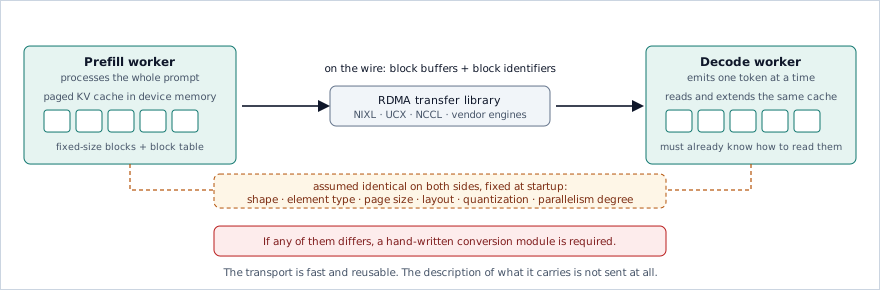
Figure 1. KV cache transfer between a prefill worker and a decode worker. The transport moves the blocks; what the blocks represent is agreed outside the transfer.
Different workers can also use different parallel decompositions. TensorRT-LLM's disaggregated-serving support [18] includes cache-layout transformation when context and generation workers use different parallel strategies.
This gives a concrete interchange problem:
Producer: "Here is the KV cache in representation A."
Consumer: "I can consume A directly," or "I require representation B."
Today this agreement is generally implemented inside the serving system. A common descriptor can make it explicit.
11. What Is Still Needed, and What Hurray Proposes
The survey suggests several requirements that are useful together:
- A common description of dense, sparse, tiled, packed, and paged layouts where these representations are shared between runtimes.
- Quantization metadata including storage type, scheme, grouping, scales, zero points where applicable, and packing.
- Memory and device information sufficient to decide how buffers can be accessed.
- Support for tensors made from several buffers.
- A way to describe shards as parts of a larger logical tensor.
- A tensor description reusable in streams and files.
- Negotiation so producer and consumer can agree on a representation before moving a large payload.
- A language-neutral runtime interface.
Supporting many representations creates complexity. A useful standard therefore needs a small common subset and explicit optional capabilities.
Hurray [19], [20] is an open-source project that defines this broader tensor description. The project is currently beta and pre-1.0. The rest of this section states what it standardizes and how it addresses each requirement above.
11.1 Interoperability boundary
Hurray standardizes the representation needed to decide whether a tensor can be consumed directly. It does not standardize the mechanism that makes the tensor accessible.
Those are two independent questions, and keeping them apart is what lets a descriptor be useful without duplicating a transport.
Representation compatibility asks whether the two sides agree on what the bytes mean: element type, shape, layout, quantization, buffer relationships, composition. Memory accessibility asks whether the consumer can reach those buffers where they currently are.
Neither answer implies the other. Two runtimes may agree exactly on BF16, a paged layout, and 64-token blocks, and still need NIXL or CUDA IPC before either can touch the other's buffers. Conversely, CUDA IPC may give one runtime access to another's GPU allocation, and that access is useless unless both sides agree on what the bytes mean.
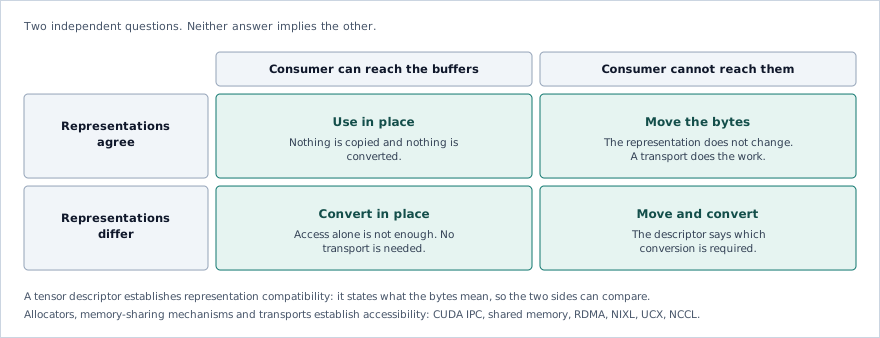
Figure 2. Representation compatibility and memory accessibility are independent. A tensor descriptor establishes representation compatibility; allocators, memory-sharing mechanisms, and transports establish accessibility.
Hurray standardizes representation compatibility. It defines the tensor's logical type and shape, physical layout, quantization information, buffer relationships, device and memory information, composition, and the synchronization information needed to determine when the data can be consumed, which is enough for an independent runtime to decide whether it can consume the representation directly.
It does not standardize how a GPU buffer is allocated, how RDMA or CUDA IPC establishes access to it, how a communication library moves it, how a kernel is scheduled, or how a runtime internally converts an unsupported representation.
In short, Hurray answers:
"What tensor is in these buffers, and how is it represented?"
The surrounding runtime and communication stack answer:
"How do I access, move, convert, or execute on those buffers?"
This keeps Hurray complementary to DLPack, CUDA IPC, UCX, NIXL, NCCL, and similar systems.
11.2 How Hurray addresses the requirements
Hurray's central object is a language-independent tensor descriptor. It describes properties including logical element type, storage type, shape, memory layout, quantization, device and memory class, buffers, synchronization, and composition. The same description can be bound to different kinds of buffers depending on where it is used: a file offset, a host pointer, and a GPU memory handle are different ways of locating data, and they do not change the tensor's shape, quantization, or layout.
The eight requirements are addressed as follows.
- Layouts. Hurray currently defines twelve layout families, covering conventional dense layouts as well as strided, sparse, space-filling, paged, and composite representations. Each layout has a tag and layout-specific parameters, so the address mapping is stated per tensor rather than fixed by a single format-wide convention.
- Quantization. Hurray treats quantization separately from storage type. Its current specification includes normative schemes for common affine quantization cases and additional low-precision representations such as NF4 and MXFP. This lets runtimes reason independently about logical type, storage type, and quantization.
- Device and memory. Device, memory, and synchronization information travels with the tensor. This does not replace CUDA IPC, RDMA registration, NIXL, or another memory-transfer API; those mechanisms provide the actual buffer access.
- Several buffers. One descriptor can reference the buffers a tensor is made from, such as values and their indexes, or values and their scales, rather than a single base pointer.
- Shards and composition. Composite descriptions let one logical object refer to several regions or tensors. This provides a basis for sharded tensors, sparse representations, quantization parameters stored separately from values, paged structures, and heterogeneous regions.
- Streams and files. The streaming form places the tensor descriptor before its payload, so a receiver can determine what is arriving before all tensor bytes have arrived. The persistent file form contains named tensors and an index for locating them, and reuses the same tensor descriptor as the streaming form.
- Negotiation. Naming the layout, element type, and quantization scheme explicitly is what makes capability comparison possible; Hurray's interchange protocol carries the exchange itself, with each side advertising the layouts it supports and a request stating an ordered preference. The worked example below turns the outcome into three cases: direct use, relocation without reformatting, or explicit conversion.
- Language-neutral interface. Hurray provides a C ABI as its runtime boundary, following the same practical approach used by DLPack and Arrow's C interfaces.
12. Hurray Compared with Existing Solutions
Hurray overlaps with DLPack on language-independent tensor exchange, with Arrow on publicly specified buffer representations, with SafeTensors on indexed persistent storage, and with GGUF on preserving low-precision representations.
It is complementary to UCX, NIXL, and NCCL, which move the data rather than describe the complete tensor.
| Capability | DLPack | Arrow tensor facilities | SafeTensors | GGUF | NIXL/UCX/NCCL | Hurray |
|---|---|---|---|---|---|---|
| Shape and element type | Struct fields | IPC message fields | Header fields | Tensor entry fields | Opaque buffers; NCCL: datatype + count | Descriptor fields |
| Dense strides | Strides field | Strides in Tensor message | Row-major only | Fixed by tensor type | Opaque bytes | Strided layout tag |
| Standard sparse representation | Not defined | SparseTensor message | Not defined | Not defined | Opaque bytes | Sparse layout tags |
| Specialized layouts | Not defined | Not defined | Not defined | Within GGML types | Opaque bytes | Layout tag, extensible |
| Paged tensor layout | Not defined | Not defined | Not defined | Not defined | Opaque bytes | Paged layout tag |
| Generic quantization metadata | Not defined | Not defined | No standardized scheme | GGML tensor type | Opaque bytes | Quantization descriptor |
| Device information | Device field | Not central | Not defined | Not defined | Transport handles | Device, memory fields |
| Sharding / composition | Single tensor | Higher-level structures | Named tensors | Named tensors | Application-defined | Composite descriptor |
| In-process ABI | C struct ABI | C Data Interface | Not defined | Library-specific | Library APIs | C ABI |
| Stream representation | Not defined | Arrow IPC, Flight | Not defined | File-oriented | Byte transport only | Streaming form |
| Indexed file | Not defined | Arrow IPC file | Header offsets | Tensor offsets | Not defined | File form with index |
| Representation negotiation | Application | Application | Not defined | Not defined | Application | Capability comparison / negotiation |
This is not a scorecard. Simpler formats can be easier to implement and more interoperable: DLPack's simplicity has helped its adoption, Arrow's strict physical formats make zero-copy interoperability predictable, and SafeTensors' restricted model makes files easy to parse safely. Hurray makes a different trade-off: it describes more physical representations in order to avoid forcing every computational tensor through one common dense layout.
A richer descriptor has to justify its complexity, and the clearest case is where converting the representation is itself expensive. If two runtimes both understand the same tiled or paged representation, converting a large tensor to row-major solely for interchange wastes memory bandwidth. If they do not understand the same representation, the conversion is unavoidable and should be explicit.
13. Example: Exchanging a Paged KV Cache
Consider a prefill worker that has produced a BF16 KV cache stored in GPU memory, divided into 64-token blocks, sharded across four GPUs, represented by a block table, and ready for a decode worker on another machine.
The transfer itself could use NIXL.
Without a shared tensor description, the two applications need a private agreement covering model-dependent dimensions, element type, block size, block-table format, shard mapping, GPU buffers, synchronization, and the relationship between transferred blocks and the request.
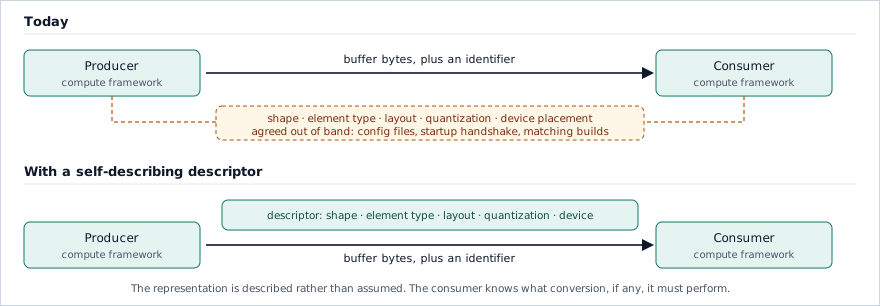
Figure 3. Application-specific agreement and descriptor-based interchange. A descriptor covers the representation; agreement about the request and the model remains application-specific.
With a common descriptor, the consumer can make one of three decisions. The result depends on both representation compatibility and memory accessibility.
Direct use. The consumer supports the same representation. No layout conversion is necessary.
Relocation without reformatting. The consumer supports the layout but needs the buffers in different GPU memory.
Conversion. The consumer requires another block size, shard mapping, element type, or layout.
The descriptor does not eliminate conversion. It identifies when conversion is required.
Use the existing representation when possible; convert explicitly when necessary.
14. Open Questions
Hurray is not yet a mature standard.
Every additional layout increases implementation work. If the standard defines too few, it cannot preserve the representations that motivated it. If it defines too many, implementations may support disjoint subsets.
Hardware layouts and quantization schemes also change quickly. Extensions are necessary, but an extension identifier alone does not create interoperability. Public layouts and quantization schemes still need precise definitions and canonical test data.
Device handles pose another boundary. A device identifier is portable metadata; a live CUDA IPC or RDMA handle is not. Hurray therefore needs to keep tensor semantics separate from transport-specific buffer access.
Security also matters. Shapes, strides, offsets, indexes, and composition metadata feed into memory calculations. Implementations need strict validation, overflow checks, fuzzing, and adversarial test cases.
Most importantly, the format needs independent implementations.
Useful conformance tests include C++ producer to Rust consumer, PyTorch to a non-PyTorch runtime, independently decoded quantized tensors, sparse tensors, paged KV caches, GPU-to-GPU transfer through NIXL, and sharded tensors with different destination layouts.
For each standard layout and quantization scheme, the project should provide small canonical byte-level examples with known results.
15. Conclusion
AI/ML systems increasingly move tensors between frameworks, accelerators, processes, machines, and storage.
For ordinary dense tensors, this problem is already well served. DLPack provides a compact in-memory ABI with shape, type, strides, byte offset, and device information. Apache Arrow provides standardized dense and sparse tensor IPC and fixed- and variable-shape tensor types in its columnar model.
Persistent formats cover another part of the problem. SafeTensors provides simple indexed model storage, while GGUF preserves a wide range of quantized model representations. Zarr and NetCDF provide scalable access to large multidimensional datasets.
Communication systems cover the data path. UCX, NIXL, and NCCL can move memory efficiently without needing to understand the complete tensor stored in that memory. ONNX carries tensor and quantization metadata as part of model interchange, while MLIR, PJRT, and DTensor demonstrate richer layout, memory-accessibility, and distributed-placement abstractions within compilers and runtimes.
At the same time, the tensors used by current compute systems are becoming more varied. PagedAttention made block-based KV-cache storage a central part of LLM serving. DistServe separated prefill and decode across GPUs. Mooncake treats KV cache as distributed state spanning GPU memory, host memory, and storage. Distributed training systems treat tensor partitioning across devices as a first-class concern.
In these cases, moving the bytes is only part of the problem. The receiver also needs to know how those bytes represent the tensor.
Hurray proposes one description for that information: shape and type, but also layout, quantization, memory placement, buffers, synchronization, and composition. The descriptor is shared between its streaming and file formats and is designed to sit above existing memory and communication mechanisms.
The proposal can be summarized in one rule:
If producer and consumer support the same tensor representation, preserve it. If they do not, describe the difference clearly enough to perform the required conversion.
Whether Hurray becomes useful will depend on adoption and interoperability, not on how many features its specification contains. Independent implementations need to agree on layouts and quantization byte for byte. Real integrations need to show that preserving tensor representations removes meaningful copies or conversions. The common subset must remain simple enough for runtimes to implement.
Apache Arrow showed the value of agreeing on the physical representation of data rather than on one library's objects. DLPack showed that the same principle works for tensors when the representation is kept small.
Hurray explores how far that idea can be extended to tensors that are quantized, sparse, tiled, paged, sharded, and resident on accelerators.
Project website: https://pgillet.github.io/hurray/
Source code and specification: https://github.com/pgillet/hurray
References
- DLPack Project. DLPack: Open In-Memory Tensor Structure,
specification and
dlpack.h. DMLC. https://dmlc.github.io/dlpack/latest/ and https://github.com/dmlc/dlpack - Apache Arrow Project. Apache Arrow Columnar Format. Apache Software Foundation. https://arrow.apache.org/docs/format/
- Apache Arrow Project. Other Data Structures: Tensor and SparseTensor. https://arrow.apache.org/docs/format/Other.html
- Apache Arrow Project. Canonical Extension Types: Fixed Shape Tensor and Variable Shape Tensor. https://arrow.apache.org/docs/format/CanonicalExtensions.html
- Apache Arrow Project. Arrow Flight RPC. https://arrow.apache.org/docs/format/Flight.html
- T. Ahmad, Z. Al Ars, and H. P. Hofstee. "Benchmarking Apache Arrow Flight: A Wire-Speed Protocol for Data Transfer, Querying and Microservices." ACM Conference on Big Data and Internet of Things (BID), 2022. https://doi.org/10.1145/3527199.3527264
- Hugging Face. SafeTensors. https://github.com/huggingface/safetensors
- GGML Project. GGUF Specification. https://github.com/ggml-org/ggml/blob/master/docs/gguf.md
- Zarr Developers. Zarr Specification. https://zarr-specs.readthedocs.io/
- Unidata. NetCDF Documentation. https://docs.unidata.ucar.edu/netcdf-c/
- OpenUCX Project. Unified Communication X. https://openucx.org/
- NVIDIA / Dynamo Project. NVIDIA Inference Xfer Library (NIXL). https://github.com/ai-dynamo/nixl
- NVIDIA. NCCL User Guide. https://docs.nvidia.com/deeplearning/nccl/user-guide/
- W. Kwon et al. "Efficient Memory Management for Large Language Model Serving with PagedAttention." SOSP, 2023. https://arxiv.org/abs/2309.06180
- Y. Zhong et al. "DistServe: Disaggregating Prefill and Decoding for Goodput-optimized Large Language Model Serving." OSDI, 2024. https://www.usenix.org/conference/osdi24/presentation/zhong-yinmin
- R. Qin et al. "Mooncake: Trading More Storage for Less Computation ---A KVCache-centric Architecture for Serving LLM Chatbot." 23rd USENIX Conference on File and Storage Technologies (FAST), 2025. https://www.usenix.org/conference/fast25/presentation/qin
- L. Zheng et al. "Alpa: Automating Inter- and Intra-Operator Parallelism for Distributed Deep Learning." OSDI, 2022. https://www.usenix.org/conference/osdi22/presentation/zheng-lianmin
- NVIDIA. TensorRT-LLM: Disaggregated Serving, including KV cache transfer and cache layout conversion across parallel strategies. https://nvidia.github.io/TensorRT-LLM/advanced/disaggregated-service.html
- Hurray Project. Hurray: A Zero-Copy, Streamable, Language-Agnostic Tensor Interchange Format for AI/ML Inference Pipelines and Scientific Arrays. https://github.com/pgillet/hurray
- Hurray Project. Hurray Project Website. https://pgillet.github.io/hurray/
- ONNX Project. Open Neural Network Exchange: IR specification and
onnx.proto, includingTensorProto,SparseTensorProto,TensorAnnotation, and external data. https://onnx.ai/onnx/repo-docs/IR.html and https://github.com/onnx/onnx/blob/main/onnx/onnx.proto - MLIR Project. Builtin Dialect: MemRefType. LLVM. https://mlir.llvm.org/docs/Dialects/Builtin/#memreftype
- OpenXLA Project. PJRT: uniform device API, and the PJRT C API header. https://openxla.org/xla/pjrt and https://github.com/openxla/xla/blob/main/xla/pjrt/c/pjrt_c_api.h
- PyTorch Project. torch.distributed.tensor: DTensor, DeviceMesh, and placement types. https://docs.pytorch.org/docs/stable/distributed.tensor.html
- Consortium for Python Data API Standards. Array API Standard: Data interchange mechanisms. https://data-apis.org/array-api/latest/design_topics/data_interchange.html
- Numba Project. CUDA Array Interface (version 3). https://numba.readthedocs.io/en/stable/cuda/cuda_array_interface.html